
TL;DR
Most contractors are estimating with an overhead number nobody ever calculated. It is 10%, a round figure that felt about right, or something another contractor said he uses.
Your real construction overhead percentage is total annual overhead divided by realistic annual revenue. Both halves of that have to be right.
The revenue half does the most damage. When sales miss plan and fixed overhead does not move, overhead eats a bigger share of every dollar and profit falls faster than revenue does.
You are running more work than you were three years ago. The phone rings, the crews are booked out, deposits keep landing, and the year feels like it is going well while you are in it. Then the books close and what is actually left does not match any of that. Plenty of money moved through the company. Very little stayed.
The reason usually is not the jobs. It is the overhead number sitting inside every estimate you wrote that year, and where it came from. For most contractors it came from nowhere. Ten percent because that is what everyone says, or a figure another owner mentioned at the supply house, or a number that was true back when you were running the business out of a truck and have not revisited since.
We covered the basic formula and the profit benchmarks around it in how much profit a contractor should make. This is the part that comes after. What actually belongs in overhead, what revenue number you divide by, how to get it back through your estimates, and when the number you calculated stops being true.
What Your Construction Overhead Percentage Actually Is
Overhead is every cost that runs whether or not you sell a single job. Your construction overhead percentage is the share of revenue those costs eat before profit starts.
The Formula
Total annual overhead ÷ realistic annual revenue = your construction overhead percentage
Example: $418,000 ÷ $2,200,000 = 19%
That company loses 19 cents of every dollar before a bundle of shingles gets bought. Sell a job at a 25% gross margin and the profit left on it is six points, not twenty-five.
Most versions of this formula stop at total annual revenue. The word doing the work here is realistic. The number on the bottom is not last spring’s best quarter multiplied by four, and it is not the target you wrote on the whiteboard in January. It is what the company can actually produce with the crews, the sales capacity, and the market in front of you.
Both halves of that division fail in their own way. The top half fails when expenses that belong in overhead are sitting somewhere else. The bottom half fails when the revenue number is a hope. Fix one and leave the other and the percentage is still wrong. The rest of this guide takes them one at a time.
Should You Calculate Overhead on Revenue or on Job Costs?
Calculate it on revenue. Overhead divided by realistic annual revenue keeps your overhead percentage, your gross margin, and your net profit on the same base, so the three numbers work together instead of needing conversion.
Both methods are in use, which is why looking this up returns overhead described as 12%, as 25%, and as 54%. Those sources are not arguing with each other. They are dividing by different things, and almost none of them say so.
Take the company above, running a 35% gross margin. That $418,000 of overhead against $2,200,000 in revenue is 19%. The same $418,000 against $1,430,000 in direct job costs is 29%. Same company, same year, same overhead, two answers ten points apart.
Either method works if you apply yours consistently. But putting overhead on a different base than your margin means doing arithmetic every time you want to compare them, and that is the kind of step that gets skipped when you are pricing a job between appointments.
That is also why the number another contractor quotes you is useless on its own. You do not know what he divided by and you do not know what he counted. Which brings up the harder half of the problem, because what counts is where most of the money goes missing.
What Counts as Overhead and What Belongs to the Job
The test is one question: would this cost exist if you did not sell this job? If the answer is no, it belongs to the job. If the cost shows up whether the phone rings or not, it is overhead.
Most contractors can sort the obvious ones. It is the middle of the list that gets left out, and every line missing from your overhead total makes your percentage look better than it is.
| Overhead | Direct Job Cost |
|---|---|
| Office and admin payroll | Crew labor on the job |
| Owner and officer compensation | Materials for the job |
| Trucks, fuel, insurance, and maintenance | Subcontractors on the job |
| Software and subscriptions | Equipment rental for the job |
| Marketing and advertising | Permits and inspection fees |
| Accounting, legal, and insurance | Dumpsters and disposal |
| Rent, utilities, and the yard | Job-specific travel |
| Warranty and callback work | Materials waste on the job |
| Crew downtime between jobs | Change order costs |
| Training, licensing, and dues | Temporary site services |
Four of those lines account for most of the damage.
Owner compensation. If you are not paying yourself a market salary as an overhead expense, your overhead percentage is understated by whatever you should be earning. The business looks profitable because it is being subsidized by you.
Warranty and callback work. The callback crew is real labor and real material, but the job it belongs to closed six months ago. Bury it back in that job’s costs and you make a finished job look worse while your overhead stays artificially low. Warranty is a cost of doing business, so it belongs in overhead where you can watch it as a percentage.
Crew downtime. Hours paid between jobs are not free and they are not the fault of the next job in line. Leave them in direct costs and whichever job happened to be open absorbs them, which quietly makes that job look like your worst one.
Vehicles. Truck payments, insurance, and fuel run the same in a slow February as in a busy July. That is the definition of overhead.
Miscategorizing costs money in both directions. Push overhead into job costs and every job looks worse than it is, which pressures you to raise prices on work that was actually fine. Pull direct costs into overhead and every job looks better than it is, which is how a company keeps bidding the same losing work and never finds out.
The Revenue Number You Plug In Decides Everything
Overhead does not care how your year goes. The office payroll clears, the truck payments draft, and the insurance renews at the same number in a slow quarter as in a good one. Revenue moves. Fixed overhead mostly does not. That gap is why a soft year hurts far more than the revenue drop suggests it should.
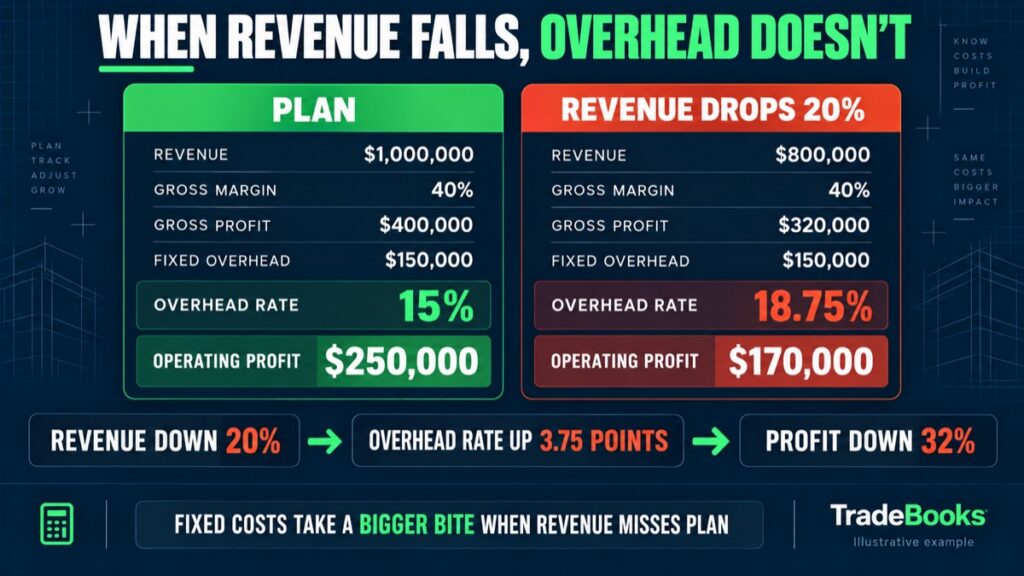
Run the numbers. A company plans for $1,000,000 at a 40% gross margin with $150,000 in fixed overhead. That is a 15% overhead rate and $250,000 in operating profit, which is what is left after job costs and overhead but before taxes and interest.
Now revenue comes in at $800,000 instead. Gross margin holds at 40%, so the crews did their part. Overhead does not move, because none of those costs were tied to volume in the first place. The overhead rate climbs to 18.75% and operating profit falls to $170,000.
Revenue down 20%. Profit down 32%.
Nothing went wrong on the jobs. The only thing that changed was the denominator, and it took a third of the profit with it. This is also why a company can be busier than ever and still come up short, because the overhead percentage baked into every bid that year was calculated against a revenue number the company never hit.
Which is the practical instruction. Build your percentage on what the company can realistically produce, not the year you are hoping for. If you are unsure, use the lower number. Setting overhead against optimistic revenue understates it on every estimate you write, and you do not find out until the books close.
One note on the figures above: 15% is a clean round number chosen to isolate the revenue effect. Plenty of contractors carry 20% or more once owner salary, vehicles, insurance, and marketing are all counted, and we broke down where those numbers land in the contractor profit benchmarks. The relationship is what matters here, not the specific rate.
Getting Overhead Back in Every Estimate
A calculated overhead percentage sitting in a spreadsheet does nothing. It only matters when it is inside the price you hand the client, and this is the step where most of the work gets undone.
Your Overhead Percentage Is Not a Markup You Add
This is the most expensive arithmetic error in the trades. Adding 19% to a cost does not recover 19% of revenue.
A job costs $10,000 to build. Add 19% and you bill $11,900. The $1,900 you collected is 16% of that price, not 19%, so you just came up three points short on a job you thought was covered. To actually recover 19 points, you divide by what is left after overhead: $10,000 ÷ 0.81 = $12,346.
The pattern holds every time. Markup is figured on your cost. Margin is figured on your price. Use the percentage as a markup and you will undercharge on every job, forever, by an amount that grows with the job size.
Overhead and Profit Are Two Separate Numbers
Recovering overhead gets you to zero. That is the entire point of the calculation, and it is where a lot of contractors stop, because “I covered my overhead” feels like it should mean something.
It does not mean you made money. It means you broke even. Profit is what you add on top of a price that already covers job costs and overhead. If you want 19 points of overhead and 10 points of profit, you are pricing to hold 29 points, not 19. This is also where gross margin gets mistaken for net profit. A 30% gross margin is not 30% in your pocket. It is what is left to cover overhead and produce profit, and if overhead is 19 of those points, the business keeps eleven. Keep them as two separate lines in your pricing, not one blended figure. Blend them and the first time a client pushes back on price, you have no way to know whether you just gave up profit or started eating into overhead. One of those is a decision. The other is a loss you will not find until the year closes.
This is also why the old 10 and 10 shorthand breaks down. It was never the worst starting point, but it assumes an overhead number almost no contractor under $15M actually carries anymore.
The Number Has to Be in the Estimate, Not in Your Head
Most contractors know their overhead percentage roughly. Knowing it roughly and applying it consistently are different things, and the gap shows up as inconsistency across the same year: full recovery on jobs priced in January, a few points shaved off the competitive bids in June, and nothing on the rush job in October where the price got set over the phone.
The fix is that overhead comes off the top as a fixed rule, before the conversation about what the market will bear. That conversation is about your profit points, not your overhead points. Overhead is a cost. It is not negotiable just because the estimate is.
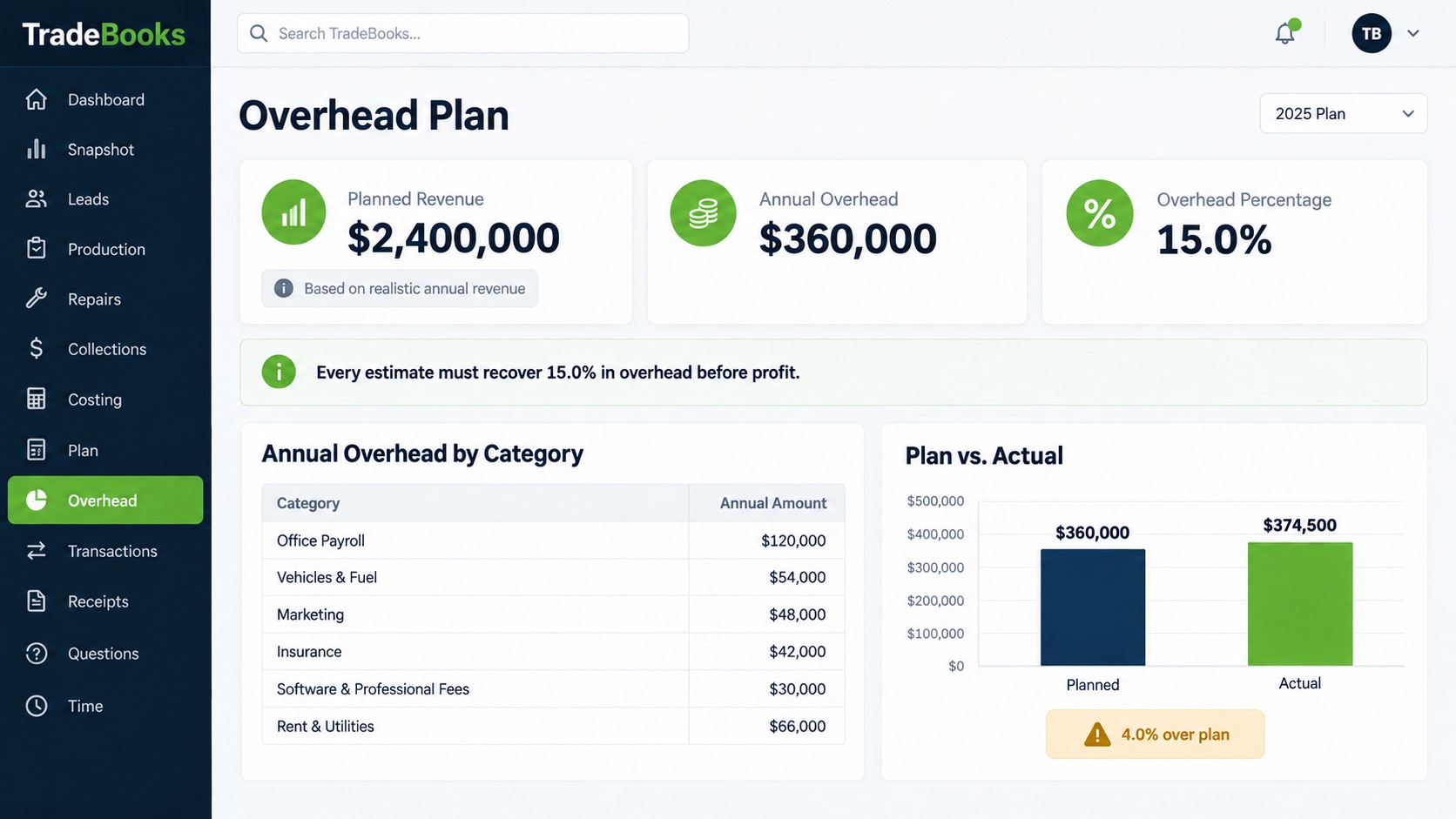
Once the percentage is built into pricing, the remaining job is watching whether it is still true. TradeBooks sets the planned overhead number from your real categories and compares actual spending against it as the year runs, so you find out a category is off plan while you can still price around it. See how overhead planning and tracking works.
When Your Number Stops Being True
Overhead is not a number you calculate once. Add a payroll position, put a truck on the road, step up ad spend, or watch revenue come in under plan, and the percentage you calculated last year is no longer the percentage you should be bidding with. It drifts, and it almost always drifts upward, because the costs a growing contracting company adds are exactly the costs that live in overhead.
Recalculate when any of these happen:
- You add someone who does not work on jobs, whether that is a project manager, an estimator, or office help
- You put a truck on the road or take one off
- Ad spend steps up or down in a meaningful way
- Insurance, workers comp, or your health plan renews at a different number
- You add software, a yard, or a lease
- Your realistic revenue changes, in either direction
Any one of those changes the number. The recalculation only counts when the new percentage goes into the next estimate you write. That last one is the one that gets missed. Most contractors think of recalculating as an expense question, so a quarter that comes in soft does not feel like a trigger. It is the biggest one there is. Costs did not move, revenue did, and the percentage you are estimating with is now understated on every bid you write for the rest of the year.
This is also why borrowed numbers fail. The Small Business Administration makes the same point in its guidance on indirect cost rates, warning businesses never to use another entity’s rate and to re-evaluate their own as conditions change. That is written for government contractors, but the reasoning is identical for a roofer in a market where insurance just went up.
Once a year is the minimum. Quarterly is better, and it is realistic if the overhead categories are being tracked against plan as the year runs rather than reconstructed at close. The difference matters: a category running over plan in week eight is a decision you get to make, while the same overage found in March is a number you get to explain.
Construction Overhead Percentage Questions
What is a good overhead percentage for a construction company?
There is no single correct number. Most contractors between $1M and $15M land somewhere between 15% and 25% of revenue, but that range is a sanity check, not a target. A company with an office, a fleet, and a salaried estimator should carry a higher overhead percentage than an owner-operator working out of a truck, and both can be run well. Your correct number is whatever your actual annual overhead divided by realistic annual revenue produces.
How do you calculate construction overhead?
Add every cost that runs whether or not you sell a job, then divide by the revenue you can realistically produce in a year. That includes office payroll, owner compensation, vehicles, software, marketing, accounting, insurance, warranty work, and crew downtime. $418,000 in overhead against $2,200,000 in revenue is a 19% overhead percentage.
What is the difference between overhead and profit in construction?
Overhead is a cost you have to recover. Profit is what you add on top after it is recovered. Covering overhead gets you to break even, not to money in the bank. If you need 19 points of overhead and want 10 points of profit, you price to hold 29 points, and the two get calculated separately so you always know which one a discount is coming out of.
Is a 10% overhead rate realistic for contractors?
Rarely, at this size. Ten percent comes from an era of smaller companies with almost no fixed cost, and it survives because it is easy to remember. Once you count owner salary, insurance, vehicles, marketing, and admin payroll, most contracting companies are well past it. Estimating at 10% when you are carrying 20% means every job is short by ten points before it starts.
Does the owner's salary count as overhead?
Yes, at market rate. Pay yourself what you would have to pay someone to do your job, and put it in overhead. Leaving it out understates your overhead percentage by exactly that amount and makes the company look profitable when it is really being subsidized by you working for free.
How often should a contractor recalculate overhead?
Once a year at minimum, quarterly if you can. Recalculate immediately after any change to fixed cost or realistic revenue, including adding office staff, putting a truck on the road, a meaningful shift in ad spend, an insurance renewal, or a quarter that comes in well under plan. A revenue miss changes the percentage just as much as a new expense does.
Why is my overhead percentage different from another contractor's?
Usually because you are not measuring the same thing. Some contractors calculate overhead against revenue and others against direct job costs, which produces numbers that can sit ten points apart for the same company. Beyond that, what gets counted varies: owner compensation, warranty work, and crew downtime are the three most commonly left out. Comparing your number to his is only useful if you know both.
What is a good overhead percentage for a construction company?
There is no single correct number. Most contractors between $1M and $15M land somewhere between 15% and 25% of revenue, but that range is a sanity check, not a target. A company with an office, a fleet, and a salaried estimator should carry a higher overhead percentage than an owner-operator working out of a truck, and both can be run well. Your correct number is whatever your actual annual overhead divided by realistic annual revenue produces.
How do you calculate construction overhead?
Add every cost that runs whether or not you sell a job, then divide by the revenue you can realistically produce in a year. That includes office payroll, owner compensation, vehicles, software, marketing, accounting, insurance, warranty work, and crew downtime. $418,000 in overhead against $2,200,000 in revenue is a 19% overhead percentage.
What is the difference between overhead and profit in construction?
Overhead is a cost you have to recover. Profit is what you add on top after it is recovered. Covering overhead gets you to break even, not to money in the bank. If you need 19 points of overhead and want 10 points of profit, you price to hold 29 points, and the two get calculated separately so you always know which one a discount is coming out of.
Is a 10% overhead rate realistic for contractors?
Rarely, at this size. Ten percent comes from an era of smaller companies with almost no fixed cost, and it survives because it is easy to remember. Once you count owner salary, insurance, vehicles, marketing, and admin payroll, most contracting companies are well past it. Estimating at 10% when you are carrying 20% means every job is short by ten points before it starts.
Does the owner’s salary count as overhead?
Yes, at market rate. Pay yourself what you would have to pay someone to do your job, and put it in overhead. Leaving it out understates your overhead percentage by exactly that amount and makes the company look profitable when it is really being subsidized by you working for free.
How often should a contractor recalculate overhead?
Once a year at minimum, quarterly if you can. Recalculate immediately after any change to fixed cost or realistic revenue, including adding office staff, putting a truck on the road, a meaningful shift in ad spend, an insurance renewal, or a quarter that comes in well under plan. A revenue miss changes the percentage just as much as a new expense does.
Why is my overhead percentage different from another contractor’s?
Usually because you are not measuring the same thing. Some contractors calculate overhead against revenue and others against direct job costs, which produces numbers that can sit ten points apart for the same company. Beyond that, what gets counted varies: owner compensation, warranty work, and crew downtime are the three most commonly left out. Comparing your number to his is only useful if you know both.
You Cannot Fix a Number You Never Calculated
Most contractors are estimating with an overhead percentage nobody ever worked out. It came from a round number, another contractor, or a version of the company that stopped existing three trucks ago. Everything downstream of that number inherits the error, one estimate at a time, until the books close and the year is already decided.
Your real number is not complicated. It is actual annual overhead divided by realistic annual revenue, with every cost counted and a revenue figure you can defend. The hard part is not the math. It is keeping the number true while the company changes and making sure it is in every price you hand a client.
That is the part TradeBooks was built to handle. Your overhead plan is built from real transactions and tracked against actuals as the year runs, so you can see a category drifting in week eight instead of finding it in March. It sits on top of the accounting program you already use, your team supplies a few daily inputs, and pricing starts at $2,500 per month for companies up to $1M in revenue.
If you want to see your own overhead run through it instead of an example, book a free 30-minute demo and we will show you where your number actually sits.
No contracts. Cancel anytime. Setup in days, not months.