

TL;DR
Roofing overhead percentage is your total annual overhead divided by your total annual revenue. A roofing company carrying $800,000 in overhead on $4M in revenue runs 20% overhead.
To price a job, divide its direct costs by what is left after overhead and profit. With 20% overhead and a 10% profit target, a job with $14,000 in direct costs prices at $20,000, not the $18,200 you get by marking up cost.
Use overhead per square (about $133 for that company) as a gut check on each bid, and track overhead coverage every month, because the slow months can fall far short.
The weather shuts you down for two weeks. The crews are home, nothing is getting installed, and the insurance premium, the truck payments, and the office payroll all still come out on schedule. That is overhead. It does not stop when the roofs do.
Most roofing owners know they have overhead. Far fewer know the actual number. They bid off a percentage someone quoted at a trade show, a figure the accountant mentioned at tax time, or a gut feel that worked when the company was half its current size. Whether that number was right shows up after the season is over, when it is too late to fix the jobs already sold.
This guide covers how to calculate roofing overhead the way a roofing company actually runs. You will learn what belongs in the number, the math mistake that quietly underprices good work, how to check a bid against what its squares and crew days should carry, and how to track overhead month to month so a slow stretch never catches you off guard.
What Counts as Overhead in a Roofing Company
Every dollar your company spends lands in one of two buckets: it belongs to a specific roof, or it belongs to the business. The fastest way to sort them is the address test. If you can write a job address next to the cost, it is a direct job cost. If you cannot, it is overhead.
The shingles on a tear-off across town have an address. Your general liability policy does not. Most costs sort themselves that easily, but roofing has a handful that do not, and those are exactly where overhead numbers go sideways. The table below shows where common roofing costs usually belong.
| Cost | Usually belongs in | Why |
|---|---|---|
| Shingles, underlayment, flashing, drip edge | Direct job cost | Bought for one roof and installed on it |
| Crew or sub crew pay, including workers’ comp on field labor | Direct job cost | Tied to hours or squares on a specific job |
| Dumpsters, disposal fees, and permits | Direct job cost | Ordered and paid per address |
| Office staff, estimators, and admin payroll | Overhead | They support every job, not one |
| Your salary at a market rate | Overhead | If you had to hire someone to do your job, it would be a real expense, even if you take it as a draw today |
| Office rent, general liability, software, phones, accounting | Overhead | Billed to the business whether you install 50 roofs or 500 |
| Marketing and lead costs | Overhead (tracked as its own line) | Spent before any job exists, which makes cost per lead and revenue per lead worth watching separately |
| Sales commissions | Your call | Paid per sale, so many roofers count them as a job cost; others keep them in overhead |
| Crew trucks and trailers | Your call | Some charge a daily equipment rate to each job; others carry the full cost as overhead |
| Production managers and supplement writers | Your call | They work across many jobs at once, but only exist because of production volume |
The “your call” rows are why two roofing companies with nearly identical operations can report overhead percentages ten points apart. Which side you choose matters less than choosing once, writing it down, and coding every transaction the same way all year. Move commissions from job cost into overhead in June and your overhead percentage jumps for reasons that have nothing to do with how the business is actually running.
How to Calculate Roofing Overhead in Four Steps
Calculating roofing overhead takes four numbers from the last twelve months: total overhead, total revenue, total squares installed, and total crew days. The first two steps give you the overhead percentage you price from. The last two turn it into quick checks for individual roofs. Each step uses one example company: a roofing contractor that brought in $4M in revenue last year, installed 6,000 squares, and logged 300 crew days.
Step 1: Add Up Twelve Months of Actual Overhead
Start with every overhead cost from the last twelve months, sorted using the table above. Use the most recent twelve months, not last year’s tax return. A tax return is built to lower your tax bill, not to show what it costs to keep the doors open, and it can be a year or more out of date by the time you are bidding off it.
Then adjust for what you already know is changing. If you hired an office manager in the fall or added a truck payment last month, those costs belong in the number now, not next year.
Example: The company’s overhead for the last twelve months comes to $800,000.
Step 2: Divide Overhead by Revenue for the Same Period
Your roofing overhead percentage is annual overhead divided by annual revenue for the same twelve months. Make sure both numbers cover the same stretch of time. Twelve months of overhead divided by nine months of revenue gives you a number that looks precise and means nothing.
Example: $800,000 ÷ $4,000,000 = 20% overhead. Twenty cents of every dollar this company collects goes to keeping the business running before any job makes a profit.
Step 3: Convert Overhead to a Cost per Square
Overhead per square is annual overhead divided by the total squares installed in the same period. A percentage tells you how heavy your overhead is. A per-square number tells you what a typical roof has to carry, which makes it a fast way to sanity-check a bid.
Example: $800,000 ÷ 6,000 squares = about $133 per square. A 30-square re-roof should be bringing in roughly $4,000 toward overhead before it contributes a dollar of profit.
Step 4: Convert Overhead to a Cost per Crew Day
Overhead per crew day is annual overhead divided by the total production days your crews worked. This number catches what the per-square method misses: a steep, cut-up roof ties up a crew far longer than a simple ranch with the same square count, and overhead keeps running the whole time.
Example: $800,000 ÷ 300 crew days = about $2,667 per crew day. A 25-square roof that takes one day carries about $3,333 in overhead by the square method. The same 25 squares on a steep roof that takes two days should carry about $5,333 by the crew day. Price that steep roof like an easy one and you leave about $2,000 of overhead unpaid.
Neither number replaces pricing from your margin and overhead percentage, which is covered in the next section. They are checks. If a bid priced the right way carries less overhead than its squares or crew days call for, take a second look at the job before you send it.
Why Your Overhead Percentage Has to Come Off the Selling Price
A roofing overhead percentage only works against the number it was calculated from. You got 20% by dividing overhead by revenue, so it is 20% of the selling price. The most common pricing mistake in roofing is adding that 20% on top of job cost instead.
Take the 30-square re-roof from the example above, with $14,000 in direct costs. Here is the same job priced two ways: adding 20% for overhead and 10% for profit to cost, and dividing cost by what is left after both (100% minus 30% equals 0.70).
| Same 30-square job | Adding 30% to cost | Dividing cost by 0.70 |
|---|---|---|
| Bid price | $18,200 | $20,000 |
| Direct costs | $14,000 | $14,000 |
| Overhead the job must carry (20% of price) | $3,640 | $4,000 |
| Left as profit | $560 | $2,000 |
| Actual profit margin | About 3% | 10% |
Both bids look reasonable on paper. Only one makes the 10% the estimator planned for. The crew can hit every number on the $18,200 bid and the job still ends up at 3%, because the profit was gone the moment the estimate went out. Starting from direct costs and pricing to the margin and overhead percentage the company actually needs is how experienced estimators build the breakdown, and it is the method to use on every bid.
If you would rather keep marking up cost, convert your percentage first. For the example company, $800,000 in overhead against $2.8M in direct costs is 28.6% of cost, not 20%. Mark up by 20% instead and the company recovers about $560,000 of overhead in a year it spent $800,000. The missing $240,000 comes straight out of profit, and it never shows up as a line item anyone can point to.
This is the same trap as confusing markup with margin, just applied to overhead instead of profit. We break down the markup side in how much profit a contractor should make. For the overhead side, the U.S. Small Business Administration’s break-even guide explains why every price has to clear fixed costs before it earns a dollar.
Overhead Doesn’t Take the Winter Off
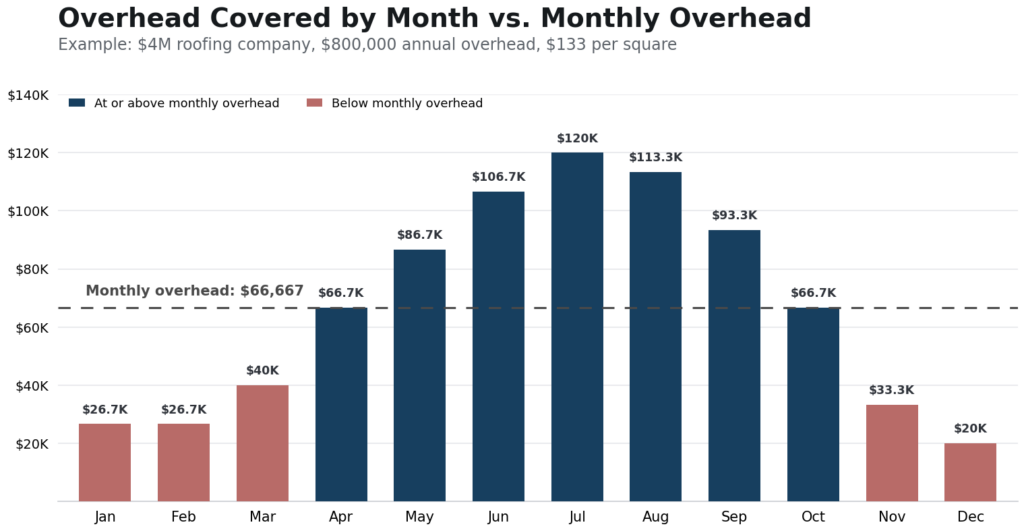
Roofing overhead comes due in equal monthly payments. Revenue does not. That mismatch is why an annual overhead percentage can look healthy while individual months quietly lose money.
Your Overhead Percentage Changes Every Month
The example company spends about $66,667 a month on overhead, busy or slow. Here is what that does to two very different months:
- July: 900 squares installed, about $600,000 in revenue. Overhead takes 11%.
- January: 200 squares installed, about $133,000 in revenue. Overhead takes 50%.
Same company, same overhead. The 20% on the annual report is just the average of months like these.
Track Coverage, Not Just the Annual Percentage
The question that matters during the year is simple: are the roofs you are installing covering the overhead you are spending? At $133 a square, this company needs about 500 squares a month to cover its overhead.
January’s 200 squares cover about $26,667, leaving $40,000 short. July’s 900 squares cover about $120,000 and win back $53,000. The year only works if the busy months build enough cushion to carry the slow ones. You want to know that by June, not in December.
Lead-to-Sale Lag Pushes Coverage Later
Marketing, canvassing, and estimator hours spent in March are overhead that only gets covered by roofs sold in April and installed in May or later. A slow spring for leads turns into a coverage problem two months down the road.
Seeing the Gap While There Is Still Time
Tracking this by hand means lining up squares, revenue, and overhead against a plan every month, and most owners never get to it. TradeBooks builds your overhead plan from your real transactions and shows plan vs. actual on one dashboard weekly, monthly, and year to date, so a coverage gap shows up while there is still a season left to close it.
What Insurance Overhead and Profit Actually Covers
On insurance work, overhead and profit (O&P) is usually added to the claim as “10 and 10”: 10% for overhead and 10% for profit, applied one after the other. It is an industry custom, not a published standard, and it is often only paid when a job needs more than one trade.
Because the percentages stack, they shrink once you look at the final price. On a claim with $10,000 in line items:
- Adding 10% for overhead brings it to $11,000.
- Adding 10% for profit on top of that brings it to $12,100.
- Overhead ends up as $1,000 of a $12,100 job, which is 8.3% of the price, not 10%.
Now compare that to the example company’s real overhead. At 20%, a $12,100 job needs to carry $2,420 in overhead. O&P pays $1,000. If your actual job costs match the line items, that job loses about $320 once overhead is covered.
In practice, many roofers’ actual material and labor costs come in under the line-item pricing, and that gap is what makes insurance work pay. That is fine, as long as you know it. The mistake is treating 8.3% as your overhead number and assuming the claim has it covered. Run insurance jobs through the same per-square and per-crew-day numbers as retail jobs, and you will see which claims actually carry their weight.
Roofing Overhead Questions, Answered
What is a normal overhead percentage for a roofing company?
Most residential roofing companies between $1M and $15M run overhead somewhere between 15% and 30% of revenue. There is no current national survey of roofing overhead, so published figures come from financial advisors working with roofers, and they vary mostly by what gets counted. Companies that include a market-rate owner salary and all marketing land near the top of that range.
What is the 20% overhead charge in roofing?
The 20% overhead charge is a flat percentage some roofers add to every job instead of calculating their actual overhead. For many residential companies it is close, since real overhead often lands near 20%. It is still a guess. A company actually running 26% overhead that charges 20% gives away six points on every job without ever seeing it.
How often should a roofing company recalculate overhead?
Recalculate your full overhead percentage at least once a quarter, and right away after any major change, like a new office hire, another truck payment, or a bigger shop. Track overhead coverage monthly in between. A number set in March can be wrong by August, and every bid written off it carries the same error into the field.
How does a new roofing company calculate overhead with no history?
Start with a budget instead of history. Add up every overhead cost you expect over the next twelve months, including a market-rate salary for yourself, and divide by the revenue you realistically expect to install. Bid off that number, then replace it with actual figures after about six months. You can see how TradeBooks builds that first plan with you.
Is roofing overhead the same as operating expenses?
Mostly, yes. On a properly set up profit and loss statement, overhead is the operating expense section below gross profit. In practice, many roofing P&Ls blur the line by booking crew trucks, sub payments, or commissions in the wrong section. Until those transactions are sorted the same way every month, the operating expense total is a rough stand-in for true overhead, not the real number.
What is a normal overhead percentage for a roofing company?
Most residential roofing companies between $1M and $15M run overhead somewhere between 15% and 30% of revenue. There is no current national survey of roofing overhead, so published figures come from financial advisors working with roofers, and they vary mostly by what gets counted. Companies that include a market-rate owner salary and all marketing land near the top of that range.
What is the 20% overhead charge in roofing?
The 20% overhead charge is a flat percentage some roofers add to every job instead of calculating their actual overhead. For many residential companies it is close, since real overhead often lands near 20%. It is still a guess. A company actually running 26% overhead that charges 20% gives away six points on every job without ever seeing it.
How often should a roofing company recalculate overhead?
Recalculate your full overhead percentage at least once a quarter, and right away after any major change, like a new office hire, another truck payment, or a bigger shop. Track overhead coverage monthly in between. A number set in March can be wrong by August, and every bid written off it carries the same error into the field.
How does a new roofing company calculate overhead with no history?
Start with a budget instead of history. Add up every overhead cost you expect over the next twelve months, including a market-rate salary for yourself, and divide by the revenue you realistically expect to install. Bid off that number, then replace it with actual figures after about six months. You can see how TradeBooks builds that first plan with you.
Is roofing overhead the same as operating expenses?
Mostly, yes. On a properly set up profit and loss statement, overhead is the operating expense section below gross profit. In practice, many roofing P&Ls blur the line by booking crew trucks, sub payments, or commissions in the wrong section. Until those transactions are sorted the same way every month, the operating expense total is a rough stand-in for true overhead, not the real number.
Know Your Overhead Before the Next Bid Goes Out
Roofing overhead is not a percentage someone hands you. It is a number your company covers or falls short of every month, one bid at a time. Build it from twelve months of real costs, price it off the selling price instead of stacking it on cost, check each bid against what its squares and crew days should carry, and watch coverage before the slow season arrives.
None of that is hard math. The hard part is keeping the numbers current while you are running crews, chasing supplements, and selling the next job. That is the work TradeBooks takes off your plate, so the overhead behind every bid is a known number instead of a year-end surprise.
If you want to see your own overhead tracked month by month against your plan, book a free demo and we will walk through it with your numbers. No commitment required.